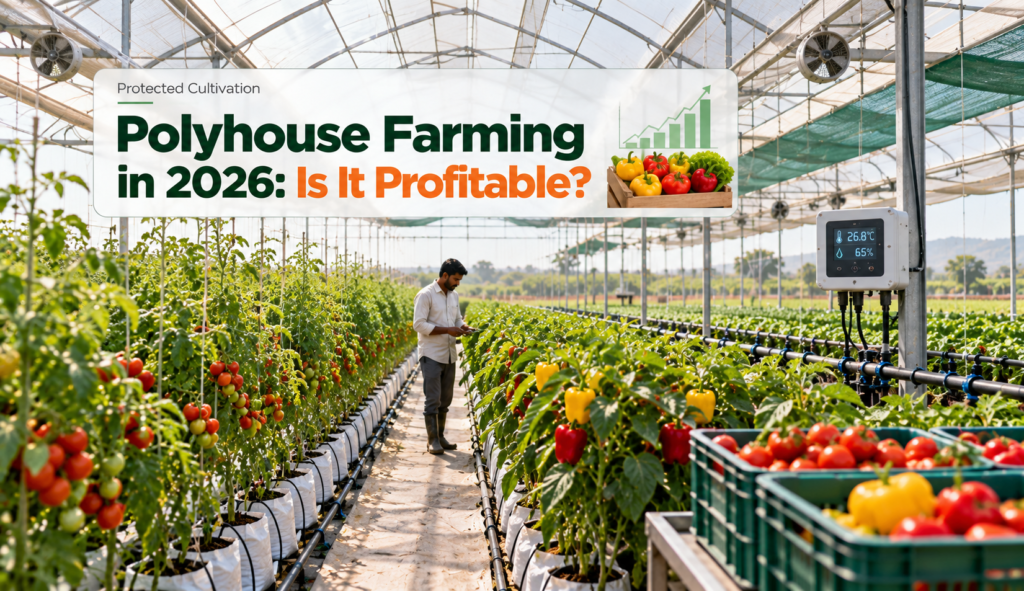
Polyhouse Farming in 2026: Is It Profitable?
Polyhouse farming is becoming an important form of protected cultivation in India, allowing farmers to control growing conditions and produce high-value crops beyond normal seasonal limitations. In 2026, polyhouse farming can be profitable when farmers select the right crop, manage production costs, use efficient irrigation and have reliable access to premium markets.
What Is Polyhouse Farming?
Polyhouse farming is a protected cultivation method in which crops are grown inside a structure covered with a transparent or semi-transparent material. The structure helps protect plants from excessive rain, heat, wind, pests and other environmental stresses.
Unlike conventional farming, polyhouse cultivation gives farmers greater control over temperature, humidity, irrigation and crop management. This makes it suitable for off-season vegetable cultivation, flowers, nurseries and other high-value horticultural crops.
The government also recognises protected cultivation as an important horticulture intervention under the Mission for Integrated Development of Horticulture (MIDH).
Is Polyhouse Farming Profitable in 2026?
Yes, polyhouse farming can be profitable in 2026, but profitability is not guaranteed. The business becomes more attractive when farmers grow high-value crops, achieve consistent yields and sell produce when market prices are favourable.
Profit depends on several factors:
- Initial polyhouse construction cost
- Crop selection and planting material
- Irrigation and fertigation expenses
- Labour requirements
- Electricity and maintenance costs
- Crop yield and quality
- Local market prices
- Transportation and storage
- Government assistance or subsidy eligibility
- Pest and disease management
Therefore, farmers should prepare a detailed polyhouse farming business plan before investing.
Polyhouse Farming Cost in India
The investment required for a polyhouse varies according to its size, design, covering material, irrigation system, climate-control equipment and automation.
A basic protected cultivation structure may require significantly less investment than a technologically advanced polyhouse equipped with automated ventilation, fertigation, sensors and climate-control systems.
The current MIDH/NHB guidelines provide cost norms for protected cultivation. For example, the 2025 guidelines list a cost norm of ₹40 lakh per acre for a polyhouse with drip and fogger systems for high-value vegetables, with additional cultivation and project components considered separately under applicable norms. These are scheme cost norms and should not be treated as a universal market construction price.
Before starting construction, farmers should compare quotations from approved suppliers and calculate the expected return on investment (ROI).
Which Crops Are Suitable for Polyhouse Farming?
Crop selection is one of the biggest factors determining the profitability of protected cultivation.
Popular options include:
- Tomato
- Capsicum
- Cucumber
- Cherry tomato
- Strawberry
- Gerbera
- Rose
- Carnation
- Chrysanthemum
- Nursery plants
- High-value leafy vegetables
Farmers should not select a crop simply because its market price is high. Instead, they should consider local climate, production cycle, input costs, disease risk, buyer demand and expected selling price.
High-value crops with predictable market demand can improve the financial potential of polyhouse farming.
Polyhouse Subsidy and Government Support in 2026
Government support can reduce the financial burden of protected cultivation for eligible farmers. MIDH covers protected cultivation as part of its horticulture development activities, while NHB also implements horticulture-related schemes under MIDH.
The 2025 MIDH guidelines include assistance for several protected-cultivation components. For example, certain polyhouse-grown flower crops have assistance provisions at 50% for specified maximum areas, while add-on technologies such as hydroponics and aeroponics also have specified assistance norms.
However, subsidy is not automatically available to every farmer or every project. Eligibility, approved components, project size, state-level implementation and applicable guidelines should be checked before making an investment.
Farmers should therefore contact their State Horticulture Department or the relevant NHB/MIDH authority for the latest 2026 requirements.
Benefits of Protected Cultivation
Polyhouse farming offers several advantages compared with open-field cultivation.
Better Crop Protection
The protected environment can reduce exposure to heavy rainfall, strong winds, excessive heat and certain pest pressures.
Efficient Water Management
Drip irrigation and fertigation can deliver water and nutrients closer to the plant root zone. This can improve resource-use efficiency when the system is correctly designed and maintained.
Off-Season Production
Farmers may be able to produce selected crops during periods when open-field production is difficult. Selling quality produce during favourable market windows can improve revenue potential.
Better Quality and Productivity
Controlled growing conditions can support uniform crop growth and improved produce quality. However, results depend heavily on crop management and environmental control.
Major Risks of Polyhouse Farming
Polyhouse farming is not a risk-free agricultural business.
High initial investment, structural damage, pest outbreaks, poor market prices, unsuitable crop selection and inadequate technical knowledge can reduce profitability.
Farmers should also account for recurring expenses such as plastic replacement, irrigation maintenance, electricity, labour, fertilisers, crop protection and repairs.
For this reason, technical training and market planning are just as important as constructing the polyhouse.
How to Make Polyhouse Farming More Profitable
Farmers can improve the financial performance of a polyhouse by following a practical approach:
- Conduct a local market survey before selecting the crop.
- Prepare a detailed cost and revenue estimate.
- Choose crops according to climate and market demand.
- Use drip irrigation and fertigation efficiently.
- Monitor temperature, humidity and soil or growing-media conditions.
- Use quality seeds or planting material.
- Follow integrated pest and disease management.
- Build relationships with wholesalers, retailers or institutional buyers.
- Maintain production and expense records.
- Check available government schemes before investing.
Modern tools such as farm sensors, automated irrigation, fertigation systems and climate monitoring can further support precision-based protected farming.
Polyhouse Farming in 2026: Final Outlook
Polyhouse farming has strong potential as a high-value and climate-smart farming business in India, particularly for farmers who can produce quality crops and connect with profitable markets. However, profitability depends on business planning rather than the polyhouse structure alone.
In 2026, farmers should focus on crop economics, market demand, efficient water management, protected cultivation technology and government support before starting a project. A properly planned polyhouse can provide an opportunity for higher-value production, but farmers should calculate the expected ROI and risks for their specific location before investing.